We had one final provisioning before our long stretch in the Tuamotus. We set up our bikes and cruised the 2.5 miles to the grocery, loaded up our haul and zoomed back. When we arrived in the Marquesas after eighteen days at sea, all we wanted was land beneath our feet. Three weeks later, we’d had our fill of mountains, fresh food, and baguettes. Mason proclaimed, ”I don’t want to go on any more hikes! We can go hiking in Seattle!”
Off to the Tuamotus then…


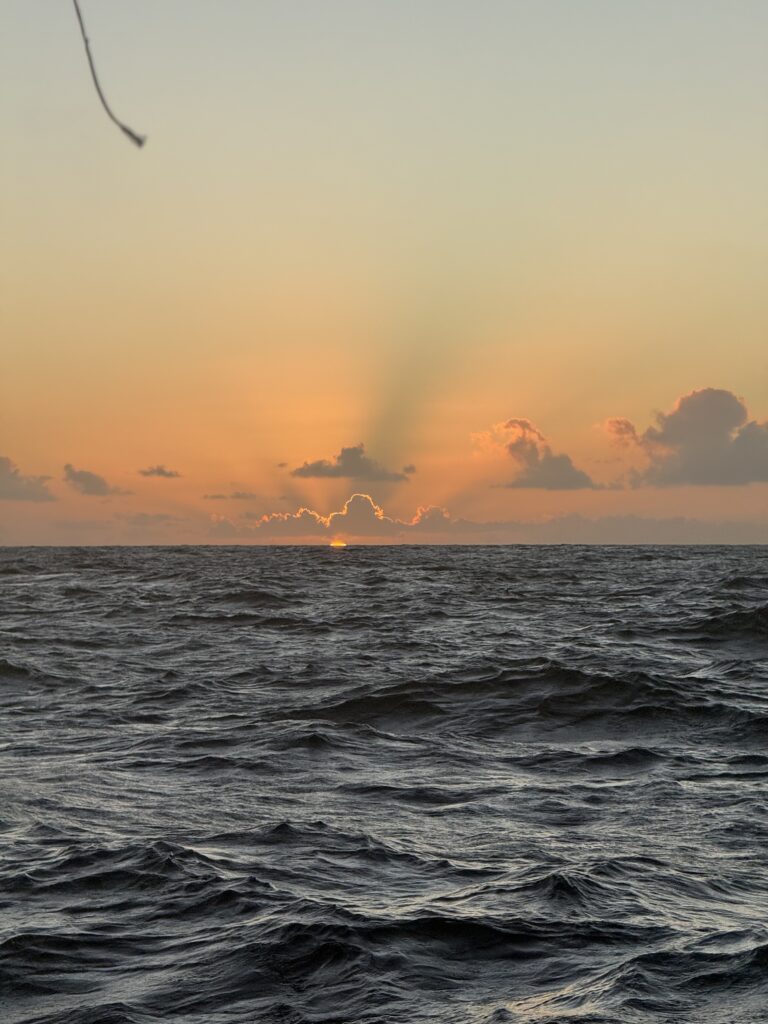
We had a speedy three-night reach from Hiva Oa to Raroia, one of the lesser-visited atolls in the Tuamotus. It’s best known as the place where Norwegian explorer Thor Heyerdahl crash-landed the Kon-Tiki raft on the outer reef after sailing from Peru in 1947. He hoped to prove that Polynesians had settled the Pacific from South America, a theory that’s now largely rejected. It’s much more likely that expert Polynesian navigators made it all the way to South America, looked around, said “nah,” and sailed home to island paradise.
The Tuamotus are known as The Dangerous Archipelago, a chain of nearly 80 coral atolls, the largest collection in the world. Unlike the towering volcanic peaks of the Marquesas, these islands barely rise above sea level. In fact, they represent the final chapter in a volcanic island’s life. Millions of years ago, each atoll began as a volcanic island, much like the Marquesas today. As the volcano slowly sank beneath the ocean, coral reefs grew around its shoreline and continued building upward toward the sunlight. Eventually the volcano disappeared beneath the sea, leaving only a ring of living coral surrounding a shallow lagoon.


Some sections of the reef have built up into narrow strips of land called motus, covered with coconut palms and scrub. Other stretches sit just inches below the surface, invisible until waves break across them. It’s easy to imagine why early sailors dreaded these waters. A low coral reef is nearly impossible to spot from a ship, especially at night, and countless vessels met their end on these reefs long before GPS existed.
Nowadays, GPS makes finding an atoll pretty straightforward. The real challenge is getting inside. Boats may enter lagoons with passes to the ocean, but tides can funnel through them at speeds faster than our boat can motor. Additionally “timing” the tides is challenging because strong trade winds can overflow the lagoon, meaning the water is continuously ebbing. Additionally, when the wind changes direction against the outflow, the pass can erupt into steep standing waves. Once you’re through, though, the ocean swell disappears, the water impossibly clear, and suddenly you’re anchored inside what feels like a giant natural swimming pool.
We timed our arrival as best we could using the tide tables, though “timed” is a generous word. Raroia greeted us with fairly intense conditions. There were only a few standing waves, but we found ourselves pushing into nearly six knots of current. To make things even more dramatic, a torrential rain squall exploded around us and we had 30 kts of wind on the nose. Nevertheless, Discovery persisted and crept into the pass at barely one knot over the ground. After the pass, I stood watch on the bow for coral “bommies” while Mason followed a wonky route he’d pieced together from satellite imagery. We couldn’t sail straight to the anchorage because of these scattered coral heads. One moment you’re over eighty feet of water; the next, there’s a coral pinnacle just below the surface. After a slow slalom through the bommies, we finally reached the protected anchorage at the north end of the atoll. The wind continued to blast, but we slept so soundly on flat water after rolling around in the Marquesas anchorages.

The water was truly phenomenal. We paddle boarded through skinny channels between motus, wing foiled across water the color of arctic blue Gatorade, and finally figured out how to crack open a coconut without destroying it (not easy). We also had to get used to the sharks that showed up at every water activity. Blacktip reef sharks cruised the shallows. Babies patrolled the beaches while larger ones lazily circled beneath the boat, hoping something interesting might come out with the gray water. Every cruiser, diver, and local gave us the same advice: reef sharks are curious but timid. They’ll check you out, keep their distance, and move on. That was our experience too until it wasn’t.


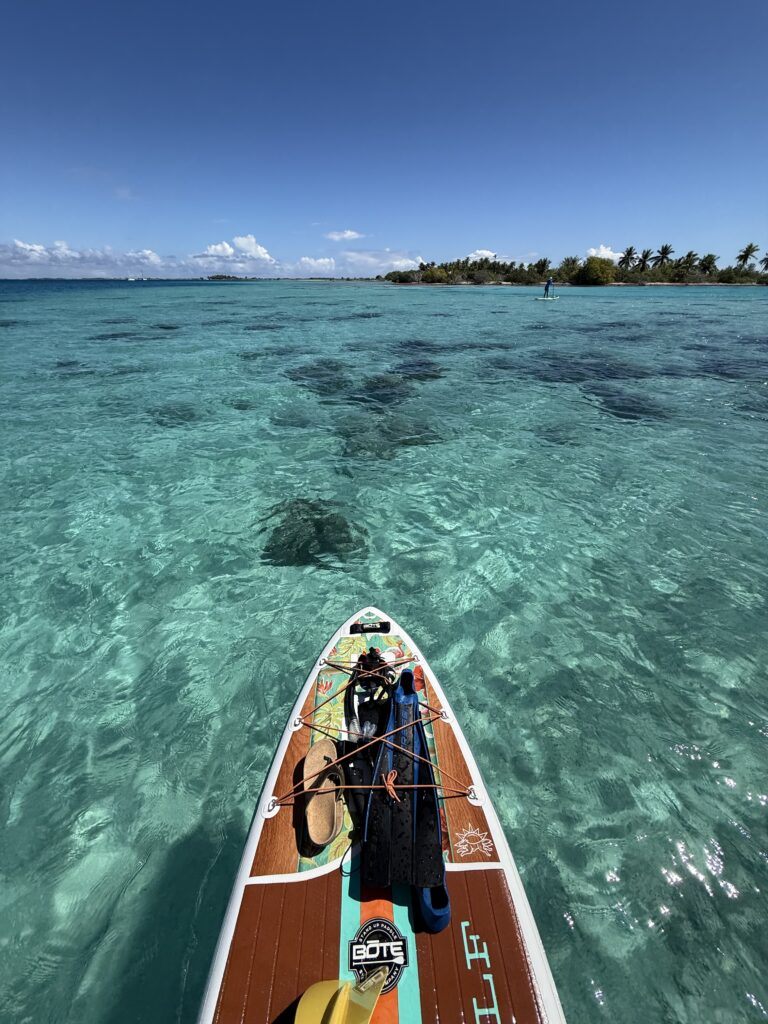
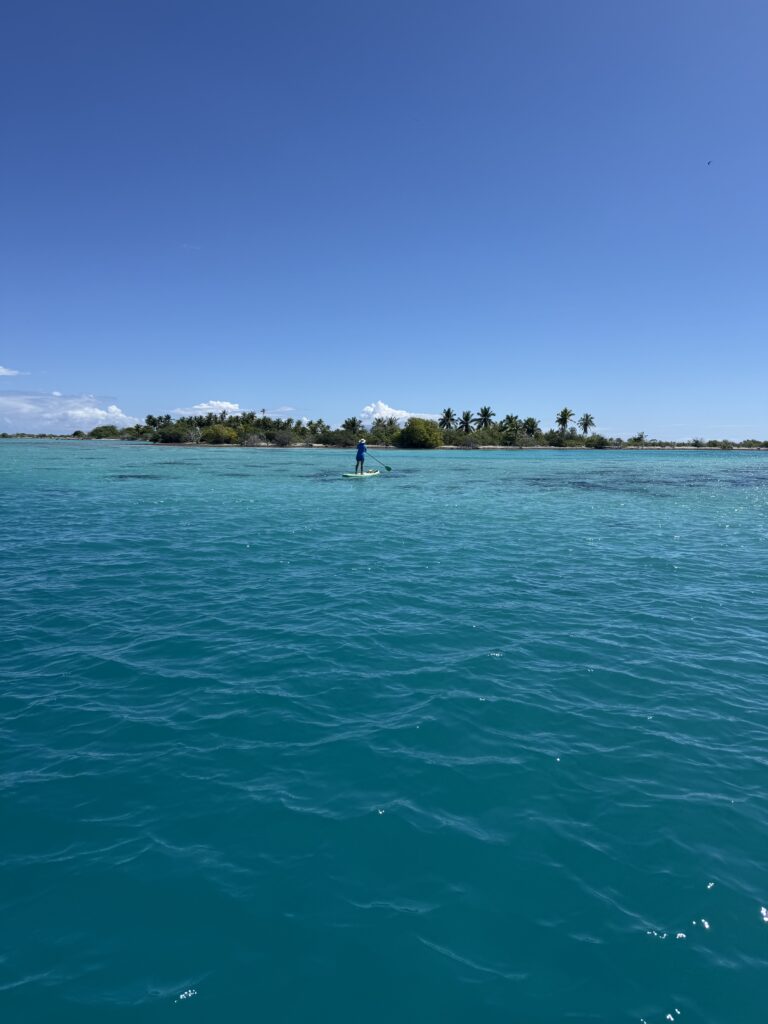


One afternoon Mason went out kite foiling and returned absolutely buzzing. The wind was ripping and he was foiling at around 20kts. “A shark chased me for a quarter mile!” he said. We naively laughed it off. Those sweet little blacktips wouldn’t hurt a fly...
The next day we went on a wing mission around a pearl farm. It was a stunning day and I was proud of my progress staying on foil in the light wind by pumping my legs & wing. We had a second shark encounter where we approached two black tips in the shallows. They immediately spun around and locked onto us. Their fins dropped, their tails started whipping back and forth, and they accelerated straight towards us. This was not the lazy, curious behavior we’d become accustomed to. Don’t Fall, don’t fall. We laughed it off again, but it was unsettling. I headed back to the boat a little early to make coconut-banana smoothies while Mason stayed out for a few more runs.
He was about half a mile away when he fell during a tack. He saw a flash of gray in the water and started scrambling back onto his board when a shark sank its teeth into his right foot. His adrenaline really kicked in, getting back up on foil quickly and beelining for Discovery. He couldn’t feel his foot, but halfway there he looked down to find his board pooled in blood. He was, quite literally, chumming the water on the ride home.
By the time he reached Discovery, his eyes were huge. “Don’t freak out,” he said. “Don’t freak out… a shark bit my foot.”

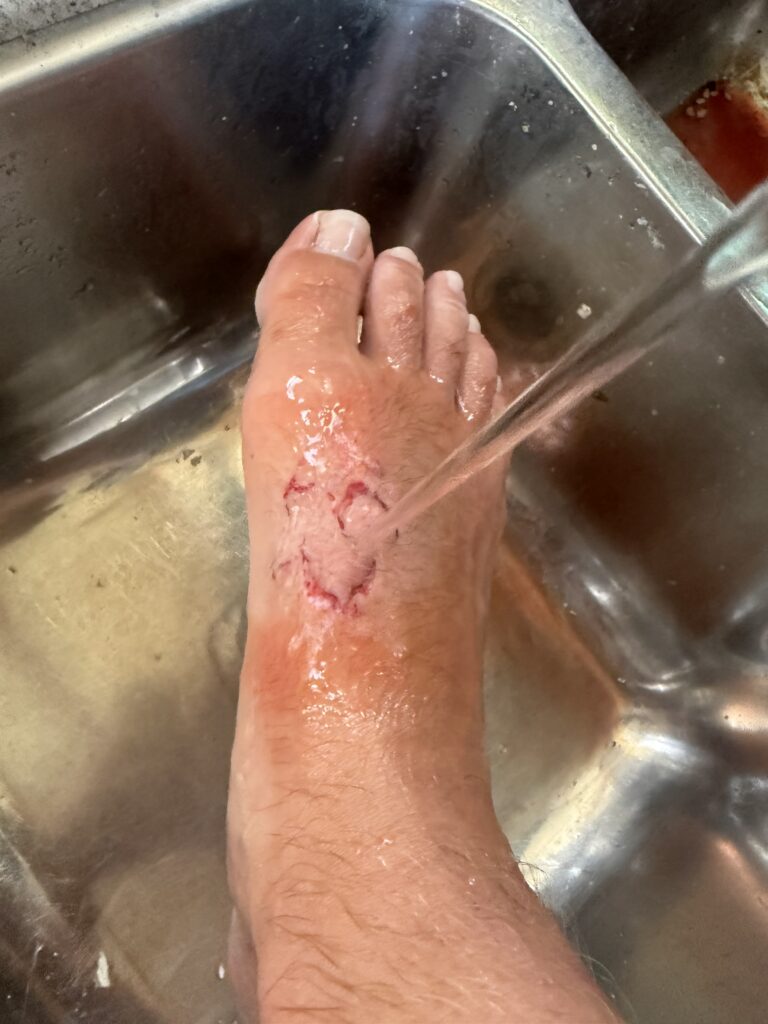

Once he was safely aboard, we could assess what happened. Mason could move his foot and squeeze his toes, which was a huge relief and a good sign that the bite was superficial. The shark had snagged the top of his foot but hadn’t damaged any tendons or muscle. Infection immediately became our biggest concern because shark mouths aren’t exactly sterile.
Medical help was a days sail away so we called our talented friend, Nurse Helen, who answered on the first ring. This was remarkably out of character, though she later told us she had a feeling the call was important. She agreed with our plan: flush the wound aggressively, start antibiotics and get to a clinic as soon as possible.
A nearby cruiser, Adam and Judith on Matabelle, had ciprofloxacin onboard and immediately offered us their supply. One of the most humbling parts of cruising is realizing how quickly people will show up for you, even when you’ve only just met. We started the first dose that evening and made plans to sail eighty miles to Makemo the following day.
The sail to Makemo was uneventful, a light and easy overnight passage. The current through the pass was strong, but the waves were manageable, and after the chaos of Raroia we were grateful for a boring sail. Our friends on Eos were also making their way to Makemo to have an injury checked out, so the next morning we all converged at the tiny island clinic. The nurse took one look at Mason’s foot and confirmed what we were hoping: no infection. She cleaned him up, gave us paraffin gauze for dressing changes, and sent us on our way. The final bill for the whole ordeal? $0! One interesting thing we learned was that clinics rarely stitch up animal bites. Closing the wound can trap bacteria inside, which is the last thing you want after a bite from an animal with a mouth full of questionable germs.


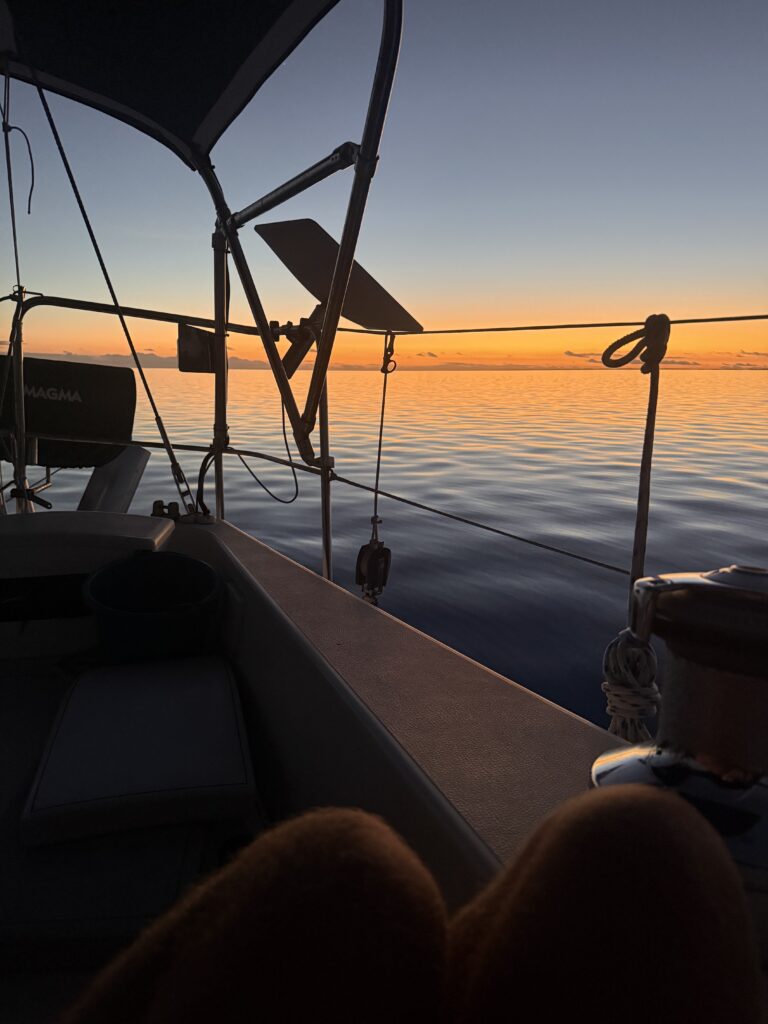
The hardest part of the whole ordeal for Mason was probably the recovery. He spent the next two and a half weeks confined to the boat, waiting for the wound to close fully. Reef water is beautiful, but it is also full of bacteria and unforgiving. A tiny open wound can quickly become a much bigger problem. The Marquesas had spoiled us with endless land adventures: hiking, mountain biking, exploring valleys, and chasing waterfalls. The Tuamotus are the opposite. Here, everything revolves around the lagoon. There are rarely paved roads, restaurants, or places to simply wander ashore (unless you count hunting for shells/coconuts). Watching everyone else go explore underwater was a fate Mason considered far worse than the shark bite itself.


Luckily, we had friends nearby with Eos and Hemisphere Dancer. Doug and Deb hosted a movie night aboard where we watched Master and Commander. Eos kept us entertained with a couple nights of Scythe and card games. Mason worked on Backtrack during the day while I tagged along with the Eos crew to explore the Octopus Garden. Maddie took all these great underwater shots:


We still don’t know exactly what triggered the shark or even what species it was, (Blacktip/ Gray/Lemon?) After researching online and talking with shark experts in Fakarava, we came up with a few theories.
This wasn’t the first time we’ve heard of sharks reacting strangely to foils. Famous surfer, Kai Lenny, recently shared footage of a downwind foil session off the Santa Barbara coast where a friend was chased by a great white for miles. There seems to be something about the vibrations and silhouette of the foil board that occasionally catches a shark’s attention, perhaps a tasty sting ray or an injured fish for an easy meal.
Another theory is that Raroia’s remoteness played a role. The atoll sees very few visitors, meaning these sharks have far less exposure to humans than the famous “Wall of Sharks” in Fakarava, where thousands of divers enter the water every year. Those sharks are accustomed to people and generally ignore them.
Its possible is that we unknowingly passed through a nursery area and the shark was displaying territorial behavior.
Maybe there was a rogue shark in the North Raroia anchorage. We heard two other instances of unusual Blacktip behavior there this season. One Blacktip rammed a cruiser while they were diving on their anchor, and another repeatedly attacked a kayak paddle for several seconds. Talk to most water lovers and they’ll tell you Blacktips are nothing to worry about, but these experiences were a good reminder that wildlife doesn’t always follow the rules we expect.
We’re still foiling, just falling less.


5 comments
Amazing as always!!!!
<3 <3 <3
WTF! I mean I love these updates, but holy crap you guys!
GREAT POST. I LOVE IT!!!!!! GOOD TO SEE LOOPS IS HAVING A GOOD TIME!!!!!! BE WELL BE SAFE SCARLET AND STELLA BLUE OUR CATS ARE FOLLOWING LOOPS!!!!
I have vague memories of learning (the hard way) to husk a coconut in the BVI with your folks. The outer husk was half the battle. Pretty sure I’ve seen pics of some contraption Brown and Eileen have that makes it easier.